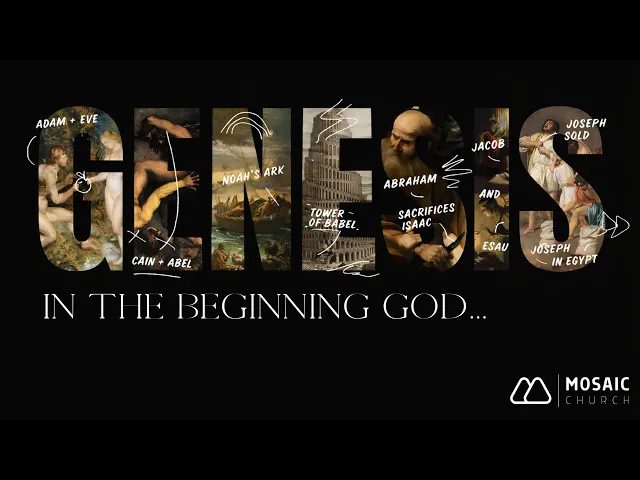
INTRODUCTION — SETTING THE SERIES
We’re beginning a series in the book of Genesis (dip in), and before we read a single verse, we need to ask a very simple question: what kind of book is this, and why does it exist?
Genesis means “beginnings,” but it’s not merely interested in how things started. It’s interested in how God wants His people to understand reality itself. Traditionally, Genesis is attributed to Moses and was written during or shortly after Israel’s rescue from Egypt (around 1400 BC), most likely while they were in the wilderness. That context matters, because Genesis is not written to curious philosophers or modern scientists. It’s written to a redeemed but disoriented people who have been brought out of slavery and are now asking, “Who is this God? What kind of world have we been brought into? What does it mean to be human? And can we trust Him?”
Genesis is not trying to satisfy every question modern people like us want to ask about the world. It is trying to form faith. It is answering the questions God’s people most needed answered. And the first thing it does is not tell us what went wrong with the world, but what kind of world this was meant to be.
OPENING
Most of us don’t wake up in the morning asking, “What kind of world do I live in?” But we answer that question every single day by how we live.
If you believe the world is fragile, you live anxious.
If you believe it is hostile, you live defensive.
If you believe it is random, the temptations is that you live frantic, the trying to create meaning wherever you can find it.
And if you believe nothing is ever really finished, you live busy and tired.
The story our culture tells us is that the world is held together by pressure, productivity, busy-ness and constant effort — that if you stop pushing, everything will fall apart. Into that kind of world, the Bible opens with a very different claim.
Before Scripture tells us what went wrong with the world, before it tells us what needs fixing, before it tells us what God calls us to as His followers, it tells us what kind of world this is. Genesis doesn’t begin with crisis. It begins with creation. Not with panic, but with purpose. Not with exhaustion, but with order.
This is a world that moves from chaos, to order, to rest.
So let’s begin where the Bible begins.
READING 1
Genesis 1:1–2
1 In the beginning, God created the heavens and the earth.
2 The earth was without form and void, and darkness was over the face of the deep. And the Spirit of God was hovering over the face of the waters.
HOW ANCIENT PEOPLE SAW THE WORLD
Genesis is not written to us. It is for us — but it is not to us. Genesis is for all peoples at all times in history, but it was only written to 1 specific group of people in a specific time and place in history. All other generations needs to do the hard work of trying to understand what Moses and indeed God is trying to tell us as current modern readers.
Before we go further, it’s important to pause and remember something about how ancient people understood the world they lived in.
If you look at ancient Egyptian illustrations, or ancient Hebrew descriptions of the world, you’ll notice a layered universe. Solid ground beneath their feet. Waters below the earth. A great dome above holding back cosmic waters. Lights moving across the sky. The sea representing danger and unpredictability. Darkness associated with uncertainty. Chaos always close.
That’s not modern science — but it was how people experienced the world.
Genesis does not correct that picture scientifically. It steps into it theologically.
So as you look at these images, notice this: Genesis is not trying to redraw the diagram of the universe. It is telling Israel — and us — who rules the universe we already know.
Genesis is not a textbook.
It is a theology book.
And because it is theology, it doesn’t just give us information — it gives us confidence. It takes the world as ancient people experienced it — sky, sea, land, lights — and declares that none of it is divine, none of it is chaotic, and none of it is beyond God’s command.
Within the Christian world, people generally hold to a variation on one of the following 4 positions:
Young Earth/Literal Creationism
Old Earth - Day/Age Creationism
Literary Framework/Theological View
Evolutionary Creation/Theistic Evolution
What unites Christians across these views:
God is the Creator of all things
Creation is intentional, not accidental
Humanity is unique and bears God’s image
Creation is good, but now broken
God is moving creation toward redemption and rest
So with that in mind, lets step back into the ancient world to listen to how Genesis tells the story.
A WORLD NOT BORN OF CONFLICT, BUT OF COMMAND
In the ancient world, creation stories usually began with violence. Gods fought. Chaos was subdued through bloodshed. Humans were created as an afterthought — slaves and servants to meet the needs of the gods.
Genesis offers a radically different vision.
“In the beginning, God created the heavens and the earth.”
No rivals.
No struggle.
No fear.
No need for human help or advice.
The earth is described as tohu wa’bohu — without form and void. Not evil. Not broken. Unfinished. And God is described as already there, hovering, present, unthreatened.
This world does not begin as a battlefield like the stories of the surrounding nations. It begins as a building site. Creation is not born out of divine anxiety, but out of divine intention.
READING 2
Genesis 1:3–13 (Days 1–3)
3 And God said, “Let there be light,” and there was light. 4 And God saw that the light was good. And God separated the light from the darkness. 5 God called the light Day, and the darkness he called Night. And there was evening and there was morning, the first day.
6 And God said, “Let there be an expanse in the midst of the waters, and let it separate the waters from the waters.” 7 And God made the expanse and separated the waters that were under the expanse from the waters that were above the expanse. And it was so. 8 And God called the expanse Heaven. And there was evening and there was morning, the second day.
9 And God said, “Let the waters under the heavens be gathered together into one place, and let the dry land appear.” And it was so. 10 God called the dry land Earth, and the waters that were gathered together he called Seas. And God saw that it was good.
11 And God said, “Let the earth sprout vegetation, plants yielding seed, and fruit trees bearing fruit in which is their seed, each according to its kind, on the earth.” And it was so. 12 The earth brought forth vegetation, plants yielding seed according to their own kinds, and trees bearing fruit in which is their seed, each according to its kind. And God saw that it was good. 13 And there was evening and there was morning, the third day.
A WORLD GIVEN ORDER AND RELIABILITY
As we hear those words, notice what God is doing. His first acts are not hurried. They are ordered.
Light is separated from darkness and time becomes meaningful.
Sky is separated from sea and space becomes stable.
Land emerges from the waters and life becomes possible.
In an ancient world where the sea represented danger and disorder, God sets boundaries. In a world where darkness was feared, God names it and limits it. This is not God imposing control. It is God being kind.
Order here is not oppressive. Boundaries are not limitations; they are gifts. God is creating a world that can be relied upon — a world where life does not need to scramble to survive, a world where chaos does not get the final word.
On days 1 to 3, we see God answering the tohu — the formlessness. He brings structure before He brings fullness. God first orders the world, and only then begins to fill it.
READING 3
Genesis 1:14–31 (Days 4–6)
14 And God said, “Let there be lights in the expanse of the heavens to separate the day from the night. And let them be for signs and for seasons,[f] and for days and years, 15 and let them be lights in the expanse of the heavens to give light upon the earth.” And it was so. 16 And God made the two great lights—the greater light to rule the day and the lesser light to rule the night—and the stars. 17 And God set them in the expanse of the heavens to give light on the earth, 18 to rule over the day and over the night, and to separate the light from the darkness. And God saw that it was good. 19 And there was evening and there was morning, the fourth day.
20 And God said, “Let the waters swarm with swarms of living creatures, and let birds fly above the earth across the expanse of the heavens.” 21 So God created the great sea creatures and every living creature that moves, with which the waters swarm, according to their kinds, and every winged bird according to its kind. And God saw that it was good. 22 And God blessed them, saying, “Be fruitful and multiply and fill the waters in the seas, and let birds multiply on the earth.” 23 And there was evening and there was morning, the fifth day.
24 And God said, “Let the earth bring forth living creatures according to their kinds—livestock and creeping things and beasts of the earth according to their kinds.” And it was so. 25 And God made the beasts of the earth according to their kinds and the livestock according to their kinds, and everything that creeps on the ground according to its kind. And God saw that it was good.
26 Then God said, “Let us make man in our image, after our likeness. And let them have dominion over the fish of the sea and over the birds of the heavens and over the livestock and over all the earth and over every creeping thing that creeps on the earth.”
27 So God created man in his own image,
in the image of God he created him;
male and female he created them. 28 And God blessed them. And God said to them, “Be fruitful and multiply and fill the earth and subdue it, and have dominion over the fish of the sea and over the birds of the heavens and over every living thing that moves on the earth.” 29 And God said, “Behold, I have given you every plant yielding seed that is on the face of all the earth, and every tree with seed in its fruit. You shall have them for food. 30 And to every beast of the earth and to every bird of the heavens and to everything that creeps on the earth, everything that has the breath of life, I have given every green plant for food.” And it was so. 31 And God saw everything that he had made, and behold, it was very good. And there was evening and there was morning, the sixth day.
A WORLD FILLED WITH LIFE AND CROWNED WITH HUMANITY
Now God fills what He has formed. He deals with the bohu problem — the emptiness.
You might have noticed it before if you’ve studied Genesis, but you’ll see that Day 1 and Day 4 go together. Day 2 and Day 5. Day 3 and Day 6.
Lights are placed to govern time.
Creatures fill the sky and the sea.
Animals roam the land.
And finally, humanity is created.
The sun and moon — worshipped as gods in ancient cultures — are simply lights. They rule nothing by divine power; they serve by God’s command.
This is one of the reasons I read Genesis 1 primarily as a theological account rather than a scientific one. God, through Moses, is deliberately undermining the gods of the nations. You worship the sun, moon, and stars as gods? They aren’t even created until day four. And they aren’t given names — they’re just “lights.” They are not worthy of worship.
Human beings, by contrast, are not accidental. They are not an afterthought. They are made in the image of God. They are given authority, but not autonomy. They rule under God, with God, not instead of Him.
And importantly, work flows from identity, not toward it.
“IT WAS GOOD… VERY GOOD”
Seven times in the chapter God calls creation ‘good' — and then finally, ‘very good’.
Before humanity achieves anything, before it proves anything, before it contributes anything, God delights in them and calls them ‘very good’.
Creation is not morally neutral; it is positively good. God does not wait to see how we perform before He calls the world good. Worth comes before work. Delight comes before duty.
It’s also helpful to say that calling creation “good” does not mean it is finished in every sense. The word “perfect” in English can be misleading.
God orders and fills the world, and then commissions humanity to continue that ordering work — to “subdue” the earth. That word means to take hold of, to tame, to place under safe and wise management.
This does not mean “God starts and we finish.” God does far more than we ever will. He places the stars in the sky and raises mountains. We make our beds in the morning. But it does mean that human work is not about earning worth. It flows out of our worth. It flows out of Gods joy in us. We work as those who already belong.
READING 4
Genesis 2:1–3
2 Thus the heavens and the earth were finished, and all the host of them. 2 And on the seventh day God finished his work that he had done, and he rested on the seventh day from all his work that he had done. 3 So God blessed the seventh day and made it holy, because on it God rested from all his work that he had done in creation.
A WORLD COMPLETE ENOUGH FOR GOD TO REST
Only now do we reach the final note of creation.
God rests.
Not because He is tired, but because nothing is lacking.
And we see how important this is when we compare the rest of the God of Genesis with the “rest” of the gods of the nations. In Egyptian cosmology, for example, the sun god Ra is born each morning strong, but by evening he has become weak from keeping chaos away. Night is not rest because the work is finished; night is danger. Ra must withdraw, sleep, fight in the shadows, and depend on other gods to protect him so that he can be reborn again the next day.
The universe survives only because the gods never stop fighting.
In Genesis our Gods is shown to be quietly but clearly different.
In Egyptian cosmology, the universe survives because the gods cannot stop working.
In Genesis, the universe is safe because God can stop working and has.
The God of Israel does not rest because He is worn out. He rests because His work is complete and the world is good.
Night-time is not a moment of chaos or threat. Darkness has been named and boundaries placed around it. The universe does not wobble while God rests. He is not asleep from exhaustion. He still holds the ordered world and everything that fills it in His good hands.
And it is safe.
It is also striking that the seventh day has no ending formula. There is no “evening and morning of the 7th day.” God’s rest remains open. Humanity’s first full day is lived not in striving, but in God’s rest — enjoying a finished world.
This tells us something profound.
This is a world stable enough for God to rest in and for us to rest in and with our God.
THE GOSPEL — A GREATER FINISHED WORK
Up to this point, Genesis has been telling us the kind of world God made — a world ordered, filled, and complete enough for God to rest in.
But that doesn’t quite sound like the world we experience.
But rest no longer comes easily to us. The Book of Hebrews in the New Testament largely focusses on the invitation and encouragement to make sure we don’t miss the rest of God through sin and by trying to be our own source of rest.
In the world around us, people stopped trusting God’s finished work.
People began living as though nothing is ever truly done.
People turned rest into striving, work into identity, achievement into worth.
So God does again what only He can do.
Jesus takes up the work we could never finish. He bears the weight we were never meant to carry. And on the cross, He echoes the language of creation itself:
“It is finished.”
Just as God rested because creation was complete, we can now rest because redemption is complete. We do not rest because we have done enough.
We rest because Jesus has done enough and it is finished.
The Bible begins by telling us what kind of world this is — not one held together by our effort, but one sustained by a God who finishes His work and invites us, in Christ, to rest.
MOSAIC CHURCH